Mohannad Ghawanmeh is an experienced arts leader with a strong commitment to art that lifts up communities and share stories and histories. He is published scholar, with a dozen recognitions and distinctions, who has developed public art in multiple cities. He is returning to the Twin Cities and Minnesota, where he attended college and worked…
Where to listen? “Listening to the Mississippi” is an iterative project, a grouping of underwater sounds recorded in and around the river, a series of artworks and actions that have unfolded over 10 years. In this iteration, the project takes the form as a series of seven soundtracks and a book, “notes for listening.” Visitors can…
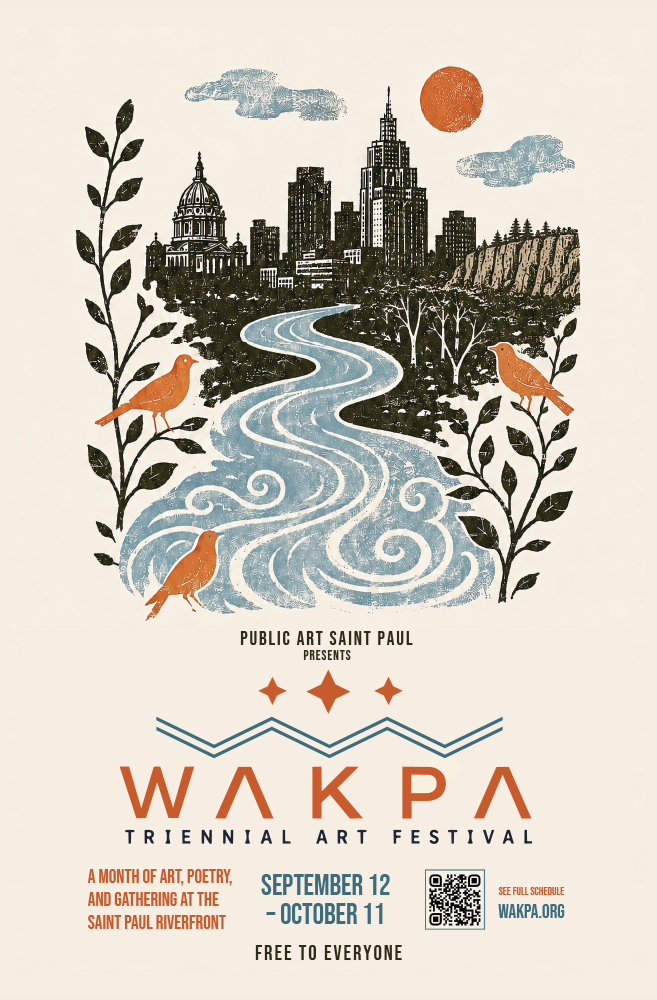
PRESENTED BY OYATE HOTANIN WITH PUBLIC ART SAINT PAUL Saturday, June 24 11 AM – 12:30 PM FREE Raspberry Island, Saint Paul Schubert Club Bandshell On this first day that Triennial art projects and installations will be open to the public, we launch the Wakpa Triennial with an event in the heart of Wakpa…
Tickets Here! From all of us at Public Art Saint Paul, we hope you will join us for a fabulous evening to gather and welcome the first installation of the Wakpa Triennial Art Festival of the Twin Cities! Join us at the Intercontinental Saint Paul Riverfront Hotel in downtown Saint Paul on Tuesday, June 20th for a delicious…
Learn more about The Seven Council Fires from the Minnesota Historical Society here. The Seven Council Fires (Oceti Ŝakowiŋ) is an overview of Dakota, Lakota, and Nakota cultural objects — totaling approximately 1,000 items — that can be found in the Minnesota Historical Society’s artifact collection.
Makxoche Washte, The Beautiful Country: A Lakota Landscape Map View the map here Rivers and streams are pinned at confluences. The only exception is the Mnishoshe (The Water-Astir; Missouri River), which is pinned at the mouth of that stream, which is the Gulf of Mexico; according to Blue Thunder, it is the Mississippi River which…
Enjoy this beginning resource for understanding more about the Dakota people’s relationship to Minnesota from the Minnesota Humanities Center. Try traveling the directions in a traditional way – East (We Are Home), South (Dakota Greeting), West Mnisota: A Dakota Place) and then North for the core of the site – the Memory Map.